
Frequently Asked Questions
Proposal Key Facts
-
Voters are being asked to consider two ballot measures in the May 19, 2026, local election.
A capital bond of $40.3 million to replace the aquatic center. Estimated tax rate of $0.64 per $1000 of assessed value for 25 years.
About the Aquatic Center Bond
-
Proposed Capital Bond: A measure not to exceed $40.36 million to fund the design and construction of an aquatic facility on the current site. The plan includes a competition-sized lap pool, a warm-water pool, and a multi-use space on a single level for ADA accessibility.
The estimated tax rate is $0.64 per $1,000 of assessed value over 25 years.
-
The 2026 bond proposal has been reduced by more than 40% from the 2024 proposal. It now focuses only on replacing the aquatic center, keeping it approximately the same size, while improving functionality, and includes fundraising and grants.
The previous proposal included non-pool items (purchasing Parkdale Park, developing Westside Park, and securing the final, missing link of the Indian Creek Trail), as well as a community center that would have been part of the aquatic center. Those capital items have been removed from the proposal.
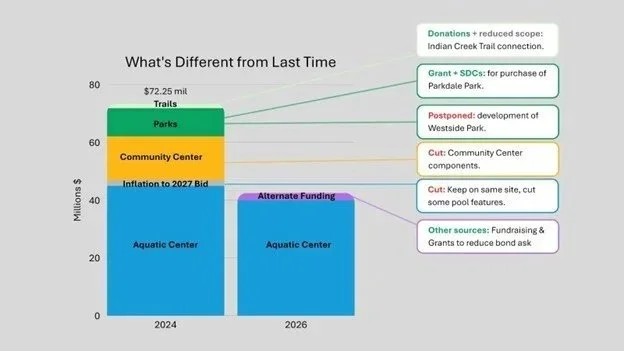
The graph below shows these cuts visually. Note that the $72.25 million project cost from 2024 is that project’s cost, with inflation added only to the aquatic center portion.
-
The new pool is designed as a replacement for the current facility, with minor upgrades to improve accessibility, safety, and usability.
The therapy pool and wade pool are combined to make the “warm” pool more multi-use.
The “warm” pool is closer to the entry and locker rooms to make it easier to reach for all ages.
A permanent roof is included to enhance building longevity, improve energy efficiency, and reduce ongoing roof maintenance.
Family changing rooms are included in the proposal, along with locker rooms.
All structural, mechanical and electrical systems will meet or exceed current building codes.
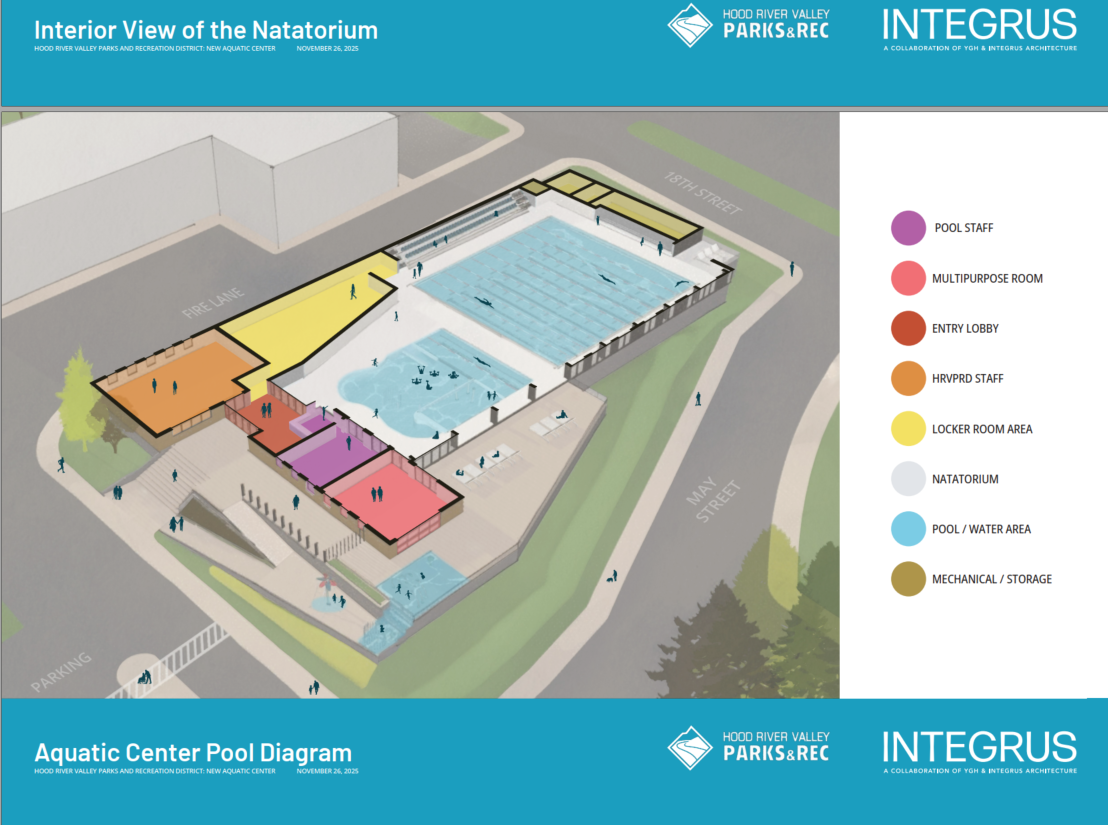
If the bond is approved by voters, the final detailed architectural design will be completed with public input. The above picture is a concept design for the proposed facility as part of the updated pool options study.
-
The rebuild will happen in two stages, totalling at most $40.3 million in bond dollars:
Phase 1: Design, bidding, permitting, and demolition
Phase 2: Construction
This phased approach will enable the district to go through a competitive bidding process before financing construction. A benefit to this approach is that a more refined, contractor-informed construction budget will be used to know how much actually needs to be borrowed. If actual bids come in lower than current estimates, less will need to be borrowed.
The District will work with a bond market consultant who will advise on the best time to sell the bonds (i.e. borrow the money).
-
Under current building codes, initiating a major renovation on one system triggers a legal requirement to bring all other systems up to 2026 standards simultaneously. This means that the current building would need to be torn down and replaced by a code-compliant one.
Cost Comparison: Renovation vs. Replacement
Renovation Cost: According to the 2025 Facility Condition Assessment, the current building contains several non-compliant safety systems, including fire suppression and electrical panels. The estimated cost to bring all current systems into code compliance without changing the facility layout or size is $30 million.
Replacement Cost: The proposed bond of $40.36 million funds a new facility on the same footprint, designed to meet modern ADA standards and current community demand, with a minimum 50-year lifespan.
Operational Impacts of Renovation
A staged renovation would require multiple, separate closures of the facility. Additionally, using the District’s limited reserve funds for individual repairs does not address the underlying structural and building code deficiencies identified in the engineering report.
-
In short, the District will keep the pool open as long as it is safe and financially responsible to do so, and we will clearly communicate when that is no longer possible. This is increasingly difficult, as engineers have already determined that the facility is at the “end of its useful life.”
To explain further:
The Aquatic Center has exceeded its expected lifespan and could experience a major failure at any time. Repairs will only postpone an eventual failure and must be balanced with the financial and workforce needs of the broader parks and recreation system. The District will evaluate each issue based on safety, cost, long-term feasibility, and community impact. The District intends to keep the Aquatic Center open as long as it is safe, meets required codes, and is financially responsible and feasible to do so. When it is no longer prudent to keep the pool open, the District will communicate that decision clearly and in advance whenever possible.
-
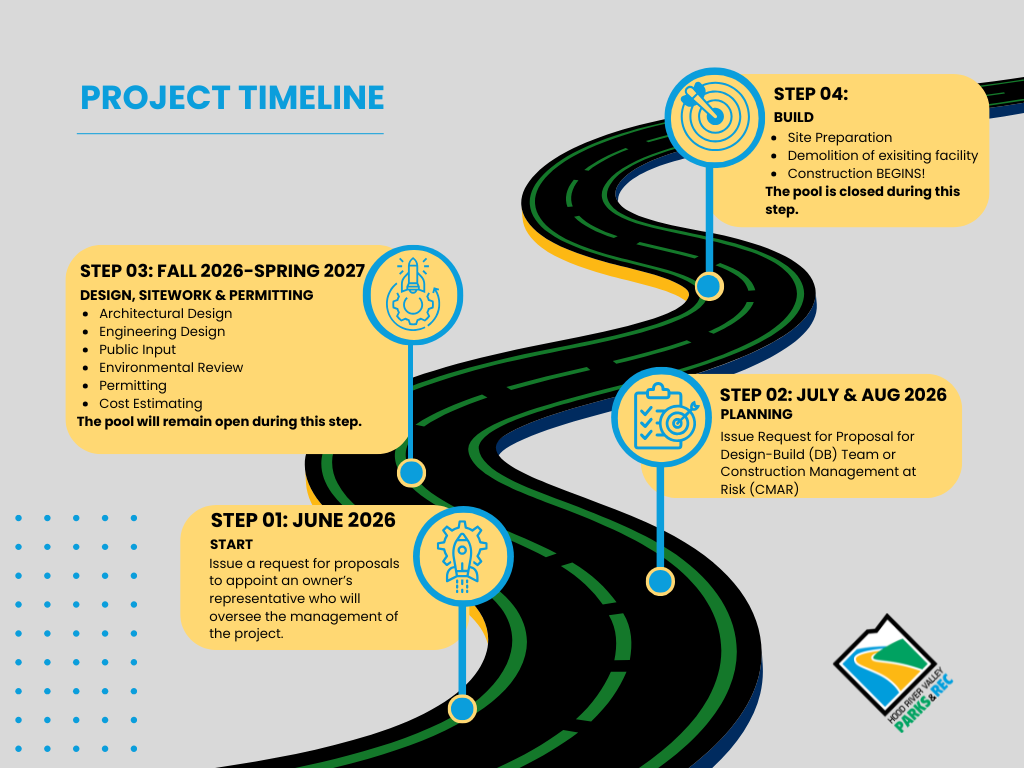
Step 01: June 2026 - Issue a request for proposals to appoint an owner’s representative who will oversee the management of the project.
Step 02: Summer 2026 - Selection process for architect -
Step 03: Fall 2026-Summer 2027, Design, Sitework/Permitting
Architectural Design
Engineering Design
Public Input
Environmental Review
Permitting
Cost Estimating
The pool will remain open during this step.
Step 04: Build
Site Preparation
Demolition of the existing facility
Construction begins
The pool will be closed during this phase of the project. The timing of the closure and the start of construction will depend on final design, permitting, and contractor availability. High school sports schedules, financing, and construction weather will be considered to minimize disruption and keep the closure as short as possible. The estimated closure period is approximately 12–18 months.
-
Comparing the costs of building aquatic centers is very complicated. There are several factors in building aquatic centers that can result in two facilities that, at first glance, look similar but differ greatly in construction costs. Comparables (“comps”) are helpful as a gut check, but will always have project-specific drivers.
Size and Types of Pools - Pools have complex mechanical systems, such as the number of pool vessels with different water temperatures and depths, which can cause large swings in the cost of mechanical systems, materials, and excavation. More gallons of water require larger pumps, filters, boilers, and treatment systems, which cost exponentially more as they get larger.
Year bid and constructed. Over the past decade, general inflation has increased about 30–35%, while construction costs have risen roughly 50–70%, meaning construction has grown about one‑and‑a‑half to two times faster than everyday inflation. The key drivers are skilled labor shortages and demand; material volatility (steel, lumber, concrete) spiked sharply during COVID and never fully reset.
Location - Regional market influences can account for 5-10% differences. State-to-state prevailing wage varies.
Wet vs Dryside Amenities - Many Recreation and community centers feature gymnasiums, workout facilities, and classroom, this “dryside” space is much cheaper to build, and often the aquatic spaces are the much more expensive parts of the building to construct because they require specialty construction (larger building span, dehumidification, vapor barrier, specialty HVAC.)
Because each pool facility is custom and a once-in-a-generation project, it is very hard to find close comparables. HRVPRD worked with an experienced architecture firm (Integrus) and expert pool consultants (Counsilman-Hunsaker) to ensure that estimated costs were well-informed by current construction costs & conditions.
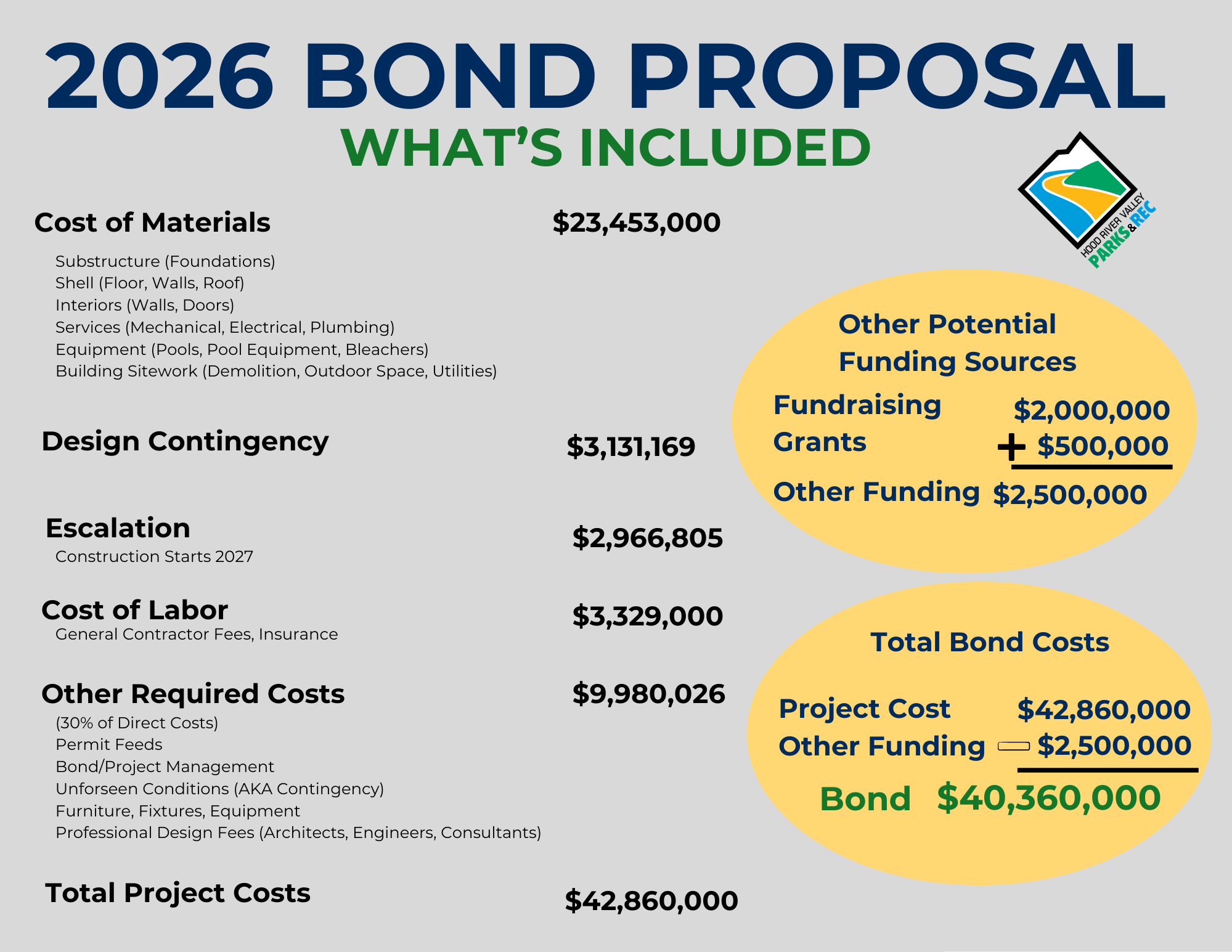
The current overall projected project cost is $42.5 million, with $2.5 million from fundraising and grants.
Comparing to previous project estimates for the Hood River Aquatic CenterThe 2020 pool-only concept for Hood River was estimated at $22,600,000. Shortly thereafter, there was a sharp increase in inflation in commercial construction.
2024 similarly-sized pool-only project in Hood River from a different architect (Opsis): $44.9 mil for a 2026 bid; $47.15 for a 2027 bid (1 year of 5% inflation).
-
The facility is expected to be closed for 12-18 months. The closure will begin when decommissioning begins, unless a major system failure necessitates an earlier closure. The exact timing will depend on many factors, such as the design process, permitting, and striving to minimize impact to pool users.
-
The cost estimates provided for our pool project were done by a highly reputable architecture firm (Integrus) and pool consultants (Counsilman-Hunsaker). They bring both general building expertise and specialized aquatic knowledge needed to accurately estimate the cost of a pool facility. Integrus has experience designing public buildings, such as recreation and aquatic centers, and understands how building size, layout, and construction methods affect cost. Counsilman‑Hunsaker focuses exclusively on aquatic facilities and has decades of experience planning, designing, and budgeting pools across the country, including the specialized systems that drive most pool construction costs.
Additionally, the final estimates were developed by a professional estimator (JMB Consulting) who consulted with three general contractors who are currently constructing aquatic centers in Oregon and Washington to get the most up-to-date project data and proven methods to produce cost estimates that reflect today’s construction market and the true complexity of building an aquatic center.The HRVPRD District board did decide to reduce the “design contingency” multiplier from 20% to 13%, which helps reduce bond cost but may create limitations to the materials that can be used.
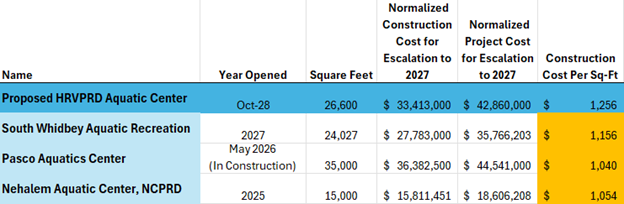
Examples of other similar aquatic centers and their costs. Normalizing construction costs is the process of adjusting historical, regional, or diverse project expenses to a common baseline, typically for time (inflation), location (geography), and currency. It enables accurate benchmarking, allowing for fair, "apples-to-apples" comparisons of costs per unit (e.g., cost/sq ft.) across different projects.
About the Levy
-
A 5-year $0.33 per $1000 of assessed operational levy for parks maintenance, pool operations, and recreation services.
-
The Levy pays for 3 categories of services:
Sustain Recreation services — youth enrichment, youth sports, and adult offerings.
Provide Aquatic Center programs and facility operations — keeping the pool clean, safe, and appropriately supervised with lifeguards and other necessary staff.
Maintain Parks and trails — scheduled maintenance, routine repairs, cleaning services, and vegetation management.
It also creates a Lifecycle replacement plan, ensuring there is funding to replace equipment at the end of its useful life. This includes items such as playground components, irrigation controls, court surfacing, pool filters, etc.
Currently, there is only money to fix the most urgent issues. Unplanned Pool Costs Take Money from Other Programs: Right now, major unplanned pool repair costs are impacting the budget that is designed to fund other HRPRD services, such as trail maintenance, youth programs, parks, and more.
-
HRVPRD has been tasked with more and more responsibilities over time, with no change to the tax rate.
Keeping Up with Trail & Park Growth: Our inventory of parks and trails has quadrupled in 15 years, yet maintenance staffing has remained the same, sharing a single person between the pool, eight parks, and nearly six miles of trails. If approved, this levy would provide the personnel needed to manage 73 acres of community land, including ball fields, shifting our service from reactive repairs to proactive management.
Protecting Community Recreation: Since 2021, the District has stepped in to save youth sports, summer camps, and enrichment programs for over 3,600 participants. The Levy closes the funding gap that fees alone cannot cover, ensuring these essential programs remain available for all local families.
-
Parks and Trails: Parks and trails maintenance will continue to be reduced, with a reactive maintenance approach and a focus on safety. General upkeep, such as trash pickup and graffiti cleanup, will occur less frequently.
Pool operations: The Aquatic Center will be closed one to two days a week, indefinitely. Closures and program cuts will be applied roughly uniformly across user groups (like swim team, family swims, etc.), so that no single group receives preferential treatment. Operating hours may also become less reliable without the appropriate funding for staff and maintenance.
Recreation programming: without levy passage, all youth and adult recreation programming will cease in September 2026. And staff will be laid off.
-
For many years, the Hood River County School District repeatedly asked the Parks and Recreation District to take over management of Community Education. While Community Education clearly aligns with Parks and Recreation’s mission, the District consistently declined. The reason is straightforward: Parks and Recreation does not have the facilities or the stable, long-term funding needed to manage the program.
In 2020, Community Education was shut down due to COVID-related regulations. At that point, the School District again approached Parks and Recreation—this time with a temporary solution. The School District offered to fund two full-time positions for three years and to provide Parks and Recreation with priority access to school facilities, creating a short-term bridge while longer-term funding could be secured. To prevent the permanent loss of community recreation programs, Parks and Recreation agreed to step in and keep these services alive.
About the Overall Proposal & Property Taxes
-
If both measures are approved, your overall total tax rate will go up approximately 6-7% next year.
The exact percentage depends on where you live, because different precincts have different totals.
You can see the impact on your tax bill, based on assessed value, by clicking the button below:
Financial Responsibility & Oversight
-
Owner’s Representative/Project Manager - An Owner’s Representative (OR) acts on behalf of the public agency to protect the owner’s interests throughout design and construction. The OR serves as the owner’s day‑to‑day advocate, coordinator, and technical advisor, helping ensure the project is delivered on time, on budget, and in compliance with public contracting requirements.
General Contractor - The General Contractor (GC) is the entity contracted to physically build the project in accordance with the approved plans, specifications, and public contract requirements. The GC is responsible for delivering the construction work safely, on schedule, and within the terms of the contract.
Citizen Oversight Committee - A Citizen Oversight Committee (COC) provides independent, community‑based oversight of bond funds to ensure that money approved by voters is spent only for the purposes described in the bond measure—such as the design and construction of a replacement aquatic center.
The committee’s role is focused on transparency, accountability, and public trust, not on managing or directing the project.
Elected Board of Directors - Five Elected Board of Directors represent the citizens of Hood River Valley. Two or three candidates are elected in May of every odd year. They meet on the third Wednesday of every month at 6:00pm. The public is encouraged to attend (virtually or in person) and they always hear public comment. They get monthly updates, review financials, set policy, and approve the budget for the Parks and Recreation District.
-
Whether or not the measures pass, regular in-district fees will be increased moderately to keep up with rising costs. The out-of-district rate will be approximately 50% more than the in-district rate. For instance, if an in-district price is $6 per visit, the out-of-district price would be approximately $9. These changes will take effect in September 2026, when they are generally updated.
Important change: The out-of-district rate will become the default, and a simple proof of residency will be required to receive the in-district rate.
-
The fundraising goal is $2 million and will focus on enhancements beyond a basic pool replacement. There are 3 areas of focus: indoor enhancements, outdoor enhancements, and indoor-outdoor connections. If the fundraising goal is not met, some enhancements shown in the concept designs may need to be cut. Find out more HERE.
-
Parks and Rec will obtain state grants from the Oregon Parks and Recreation Department for the outdoor amenities and energy efficiency upgrades. If both expected grants are awarded, they would total about $600,000 or more and contribute to ongoing utility cost savings. There is high confidence that this goal is appropriate based on extensive research of grants available for this type of facility
Grants for year-round indoor aquatic centers are very limited. Here is an extensive list of all the grants we explored, along with each grant’s viability.
About Parks & Rec
-
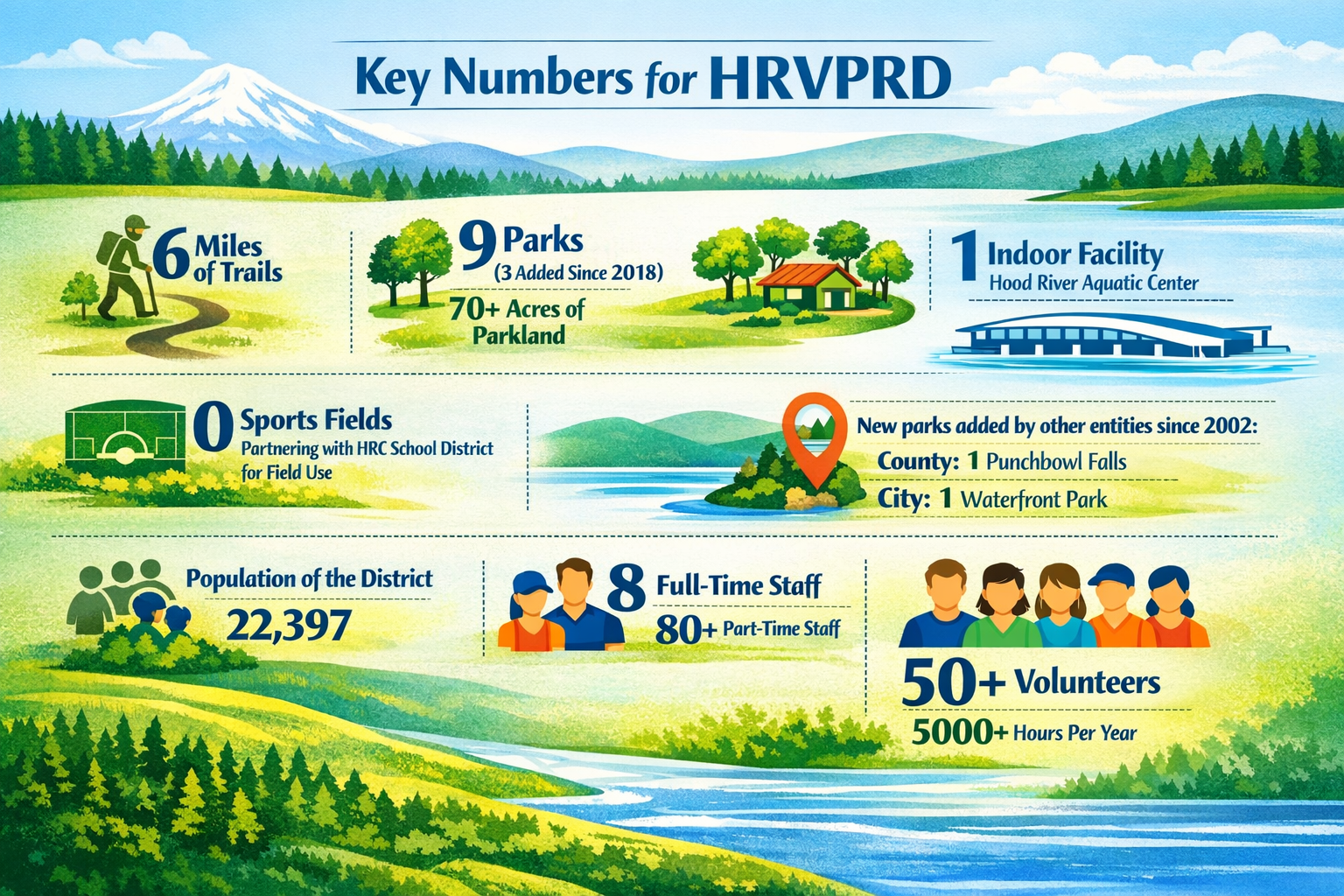
HRVPRD is a special service district serving all of Hood River County, except the City of Cascade Locks. It operates and maintains the Hood River Aquatic Center, including swim lessons and aquatic programming; develops and maintains parks and trails; and, since 2021, offers youth and adult recreation programming. While the City and County of Hood River also operate parks within their boundaries, HRVPRD has become the primary provider of new parks in the county since 2002. HRVPRD is overseen by a 5-member board of directors, each elected at-large within the district for 4-year terms.
Miscellaneous Questions
-
HRVPRD is responsible for multiple things: providing park and trails, operating the aquatic center, and providing recreation services. These needs are assigned to HRVPRD through its voter-approved charter and numerous community-informed parks master plans.
The various needs must be balanced over time. Purchasing land for parks is a long-term investment that costs more and is more difficult to fit into the landscape, the later it is done. Several of the parcels HRVPRD has purchased 50% with grant funds. Additionally, the costs of buying parkland versus rebuilding the pool are on different scales. Parkland generally costs in the 100s of thousands of dollars, while a rebuilt pool costs 10s of millions. Buying no parkland could have a small impact on the bond total, but would not solve the problem and come at the cost of not fulfilling another significant part of HRVPRD’s role in the community.
What is the restriction that prevents the Barrett property from being leased while HRVPRD still owns it?
One point of controversy over the years has been Barrett Park. There are advocates for selling Barrett Park and advocates for preserving it. The District is striving to balance these varied perspectives and aims to have a new long-term plan for the Park by approximately 2032. Two key factors are planned into this timeline:
In recent years, HRVPRD has explored a partnership with the school district and community college to use Barrett Park for an Ag-Tech program. This idea stalled due to staffing changes at the educational agencies, but it is still being discussed.
Because the property was purchased with a state parks grant, it cannot be leased for farming or any other non-recreation use. Due to grant restrictions, if the Barrett property were sold before 2032, half the proceeds would have to be returned to the state. It is appraised at $900,000. If sold now, it would only yield approximately $450,000. If sold in 2032 or later, all proceeds would stay local.
Due to the penalty for selling the land prior to 2032, selling Barrett Park is not being considered at this time.
-
One point of controversy over the years has been Barrett Park. There are advocates for selling Barrett Park and advocates for preserving it. The District is striving to balance these varied perspectives and aims to have a new long-term plan for the Park by approximately 2032. Two key factors are planned into this timeline:
In recent years, HRVPRD has explored a partnership with the school district and community college to use Barrett Park for an Ag-Tech program. This idea stalled due to staffing changes at the educational agencies, but it is still being discussed.
Due to grant restrictions, if the Barrett property were sold before 2032, half the proceeds would have to be returned to the state. It is appraised at $900,000. If sold now, it would only yield approximately $450,000. If sold in 2032 or later, all proceeds would stay local.
Due to the penalty for selling the land prior to 2032, selling Barrett Park is not being considered at this time.
What is the restriction that prevents the Barrett property from being leased while HRVPRD still owns it?
Because the property was purchased with a state parks grant, it cannot be leased for farming or any other non-recreation use.